CTO
A well-managed EDR with expert response often closes more risk for small teams than a self-managed XDR platform. More features and dashboards can actually increase gaps if your team cannot keep up.
Security tools only work if someone can act on what they reveal, and that's where the comparison between XDR vs EDR actually turns. Stacking more dashboards and data feeds does not automatically mean faster or better responses to real threats.
A well-tuned endpoint detection and response system, especially one paired with a managed response service, often covers the risks that matter most for teams with fewer than forty users. So the difference between EDR and XDR is not really about which technology is more advanced; it comes down to whether your team can actually operate what you give them.
That matters most when the team is small, because every extra platform means more alerts to triage and more moving parts to keep straight. As a result, the promise of unified security operations with XDR can quietly open gaps in coverage rather than closing them.

Each new security console looks like an upgrade on paper, but someone still has to learn it, configure it, and check it daily. For a small team, that learning curve eats into the hours that would otherwise go toward the actual job: keeping the business safe.
A single, well-managed EDR tool paired with a managed detection and response service sidesteps that problem by staying easy to run day to day. Your team can watch for genuine threats instead of switching between dashboards, and the simpler the setup, the less chance that something important slips through unnoticed.
For most small businesses, the shortfall is rarely the technology itself but the time and specialist knowledge needed to drive it properly. The more tools layered on, the more alerts compete for attention, and the higher the odds that a critical one gets missed. That is why a simpler system backed by expert support tends to close more real risk than a sprawling platform nobody has time to master.
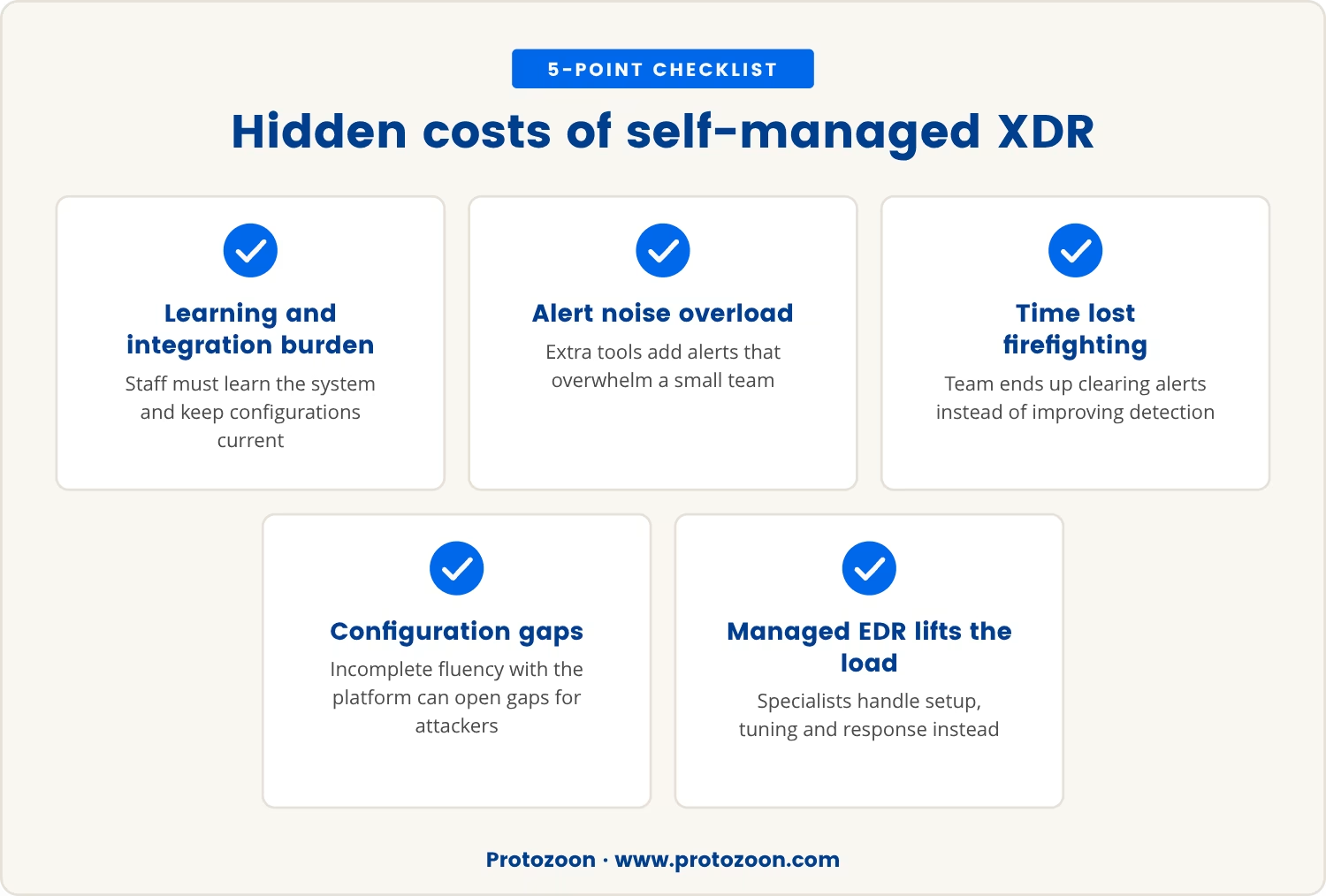
More features promise better protection, but running an XDR platform in-house carries costs that do not show up on the price tag. Staff must learn the system, build out integrations and keep configurations current, all while handling their usual workload.
Each added tool brings its own stream of alerts and reports, and for a small team that stream turns into noise fast. Rather than sharpening threat detection and response, the team can end up spending most of its time clearing low-priority alerts or fixing the platform itself.
Configuration mistakes compound the problem: if the team is not fully fluent in every part of the XDR solution, gaps open up for attackers to exploit. In London, where businesses contend with both local and global threats, those gaps carry a real cost.
A managed EDR service removes much of that weight by handing setup, tuning, and response to specialists, freeing staff to focus on their core work. For businesses that want solid protection without taking on a platform to babysit, that trade-off is often the better one.
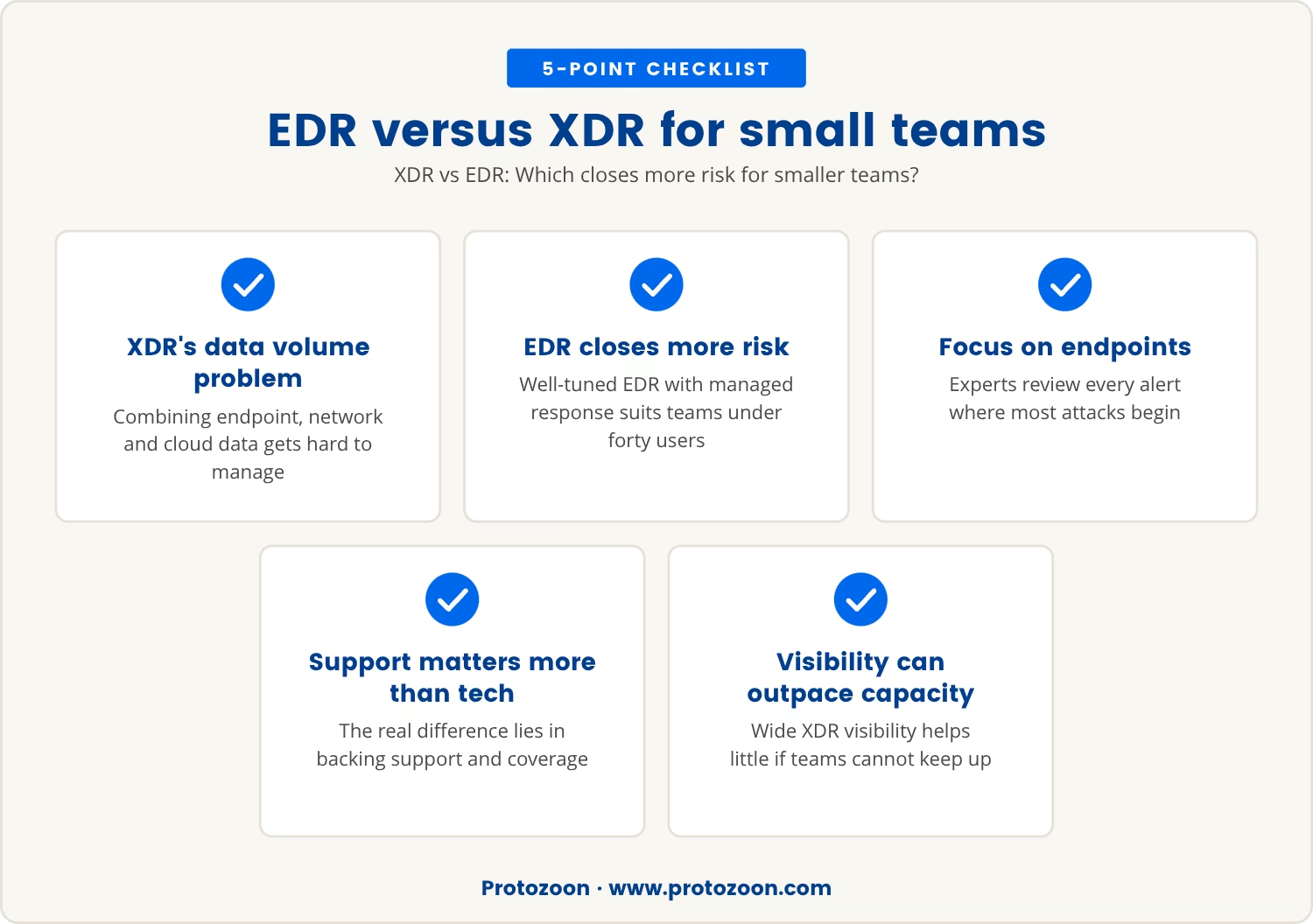
Vendors pitch XDR as the future of security operations, yet that pitch looks different once you're a small business running the numbers. XDR platforms pull together data from endpoints, networks and cloud services, which sounds ideal right up until someone has to manage and act on that volume of information.
For a team under forty users, a well-tuned EDR paired with managed response typically closes more risk than that broader platform. EDR concentrates on endpoints, where most attacks actually begin, and every alert passes through experts who know what they're looking at. Because the managed response layer handles the acting as well as the detecting, threats get addressed quickly rather than just logged.
Set the two side by side and the real difference is not the technology but the support and coverage behind it. XDR can offer wider visibility, yet if the team cannot keep pace with its volume and complexity, genuine threats slip through that visibility anyway. EDR with managed response stays simpler, more focused, and for smaller teams, more effective in practice.
Managed response turns EDR from a tool that merely watches into one that actually acts. A few of the mechanics behind that shift:
Security professionals review every alert and step in when action is needed, which cuts false alarms and speeds up the response to genuine threats.
Threats do not clock off at the end of the working day, so managed response teams keep watch on endpoints around the clock, covering the hours your own staff is offline.
Rather than waiting on alerts to fire, managed response teams actively hunt for signs of compromise, catching problems before they escalate into major incidents.
Managed services keep the EDR system updated and tuned to your specific environment, which lowers the odds of a threat slipping past outdated rules or settings.
Regular reports and plain guidance on what's been done keep you aware of exactly where your security stands at any given moment.
XDR can still be the right call for a smaller team in certain circumstances. Heavy reliance on cloud services, a large remote workforce, or strict compliance obligations all make the broader visibility of XDR genuinely useful.
That said, the benefit only materialises if the team can absorb the added complexity that comes with it. Dedicated IT staff experienced in security operations, or a trusted partner willing to manage the platform on your behalf, make that complexity manageable.
For most small businesses, though, those extra capabilities go largely unused. The practical risk is paying for features you can't fully exploit while losing the sharper, more focused protection a managed EDR service delivers instead.
Knowing where EDR and XDR genuinely diverge makes the choice between them far clearer. The main points worth weighing:
The best security strategy is whichever one your team can actually operate day to day. For many businesses in London and comparable cities, unified threat detection and response across every system sounds appealing in theory. Yet when the team is already stretched, adding more tools tends to raise risk rather than lower it.
A managed EDR service keeps the picture simple and focused, letting you respond to threats quickly instead of drowning in alerts or wrestling with integrations. For teams with limited resources, that approach consistently delivers stronger results.
Before deciding, ask whether your team genuinely has the time and expertise to run a complex XDR platform. If the honest answer is no, a managed EDR solution is likely to close more risk and leave you with greater peace of mind.

If you’re running a business with 5 to 40 users, you may be weighing the pros and cons of managing a complex XDR platform versus using a managed EDR service. At Protozoon, we understand how easy it is for small teams to get overwhelmed by too many tools and alerts.
We invite you to see how our approach can help you focus on real risks and reduce the noise. Let’s talk about what would work best for your setup.
We’ll pay up to one month of your old MSP’s charges when you move your security services to us, making your transition easier and less costly.
[.mspl-button-text]Start your transition[.mspl-button-text]
EDR tools monitor and protect endpoints like laptops and servers, sending alerts about suspicious activity so the team can respond directly. XDR platforms pull in data from endpoints, networks, cloud services, and sometimes email too, which means more information but also more complexity, and typically more time and expertise spent tuning alerts and investigating incidents.
Yes, MDR services commonly use EDR tools as their foundation, with the MDR team monitoring endpoints, investigating alerts and responding to threats on the business's behalf. This suits small teams particularly well when there is no dedicated security staff on hand.
EDR suits businesses wanting focused device protection backed by expert response support. XDR suits organisations needing visibility across endpoints, networks and cloud environments, provided they have the resources to manage the extra complexity that comes with it.
XDR platforms often include some SIEM-like features, such as centralised logging and correlation, though SIEM tools remain more flexible and cover a wider range of data sources. XDR may be sufficient for small businesses, while larger organisations or those under strict compliance demands might still need a dedicated SIEM.
A team comfortable managing multiple security layers, tuning alerts and responding to incidents across different systems is likely ready for XDR. Otherwise, a managed EDR service remains the safer, more practical choice for smaller teams.

Matt is a technology and cybersecurity expert with extensive experience in networks, compliance, data security, and IT strategy. Known for his practical expertise and personable approach, he helps businesses solve technology challenges, strengthen security, and plan for recovery.
