CTO

Restoring systems after ransomware without fixing the original vulnerability can lead to another attack through the same weakness. Businesses that skip root-cause analysis risk facing the same disruption again, even after a full recovery.
When ransomware takes a business offline, every hour of downtime costs money, every unrecovered file is a potential loss, and every shortcut taken under pressure can leave the door open for the same attacker to walk back in.
That pressure shapes how most businesses respond. The instinct is to restore from backups or rebuild affected machines as fast as possible, since getting systems running again feels like the whole job.
Yet speed on its own solves only half the problem. If the weakness that let the ransomware in in the first place is never identified and closed, that same attacker, or a different one entirely, can exploit it a second time, which means restoring data brings systems back without making them safe.
So a business can end up believing it is secure while the entry point the attacker used remains wide open, and it is that gap between feeling recovered and actually being protected where the real damage tends to follow.

After a ransomware infection, speed usually gets treated as the top priority, since every extra hour of downtime adds to the money and reputation at stake. But chasing that speed on its own creates a hidden danger.
Restoring systems without first working out how the ransomware got in risks putting the exact same vulnerability straight back into the environment, whether that is an unpatched server, a misconfigured firewall, or software nobody got round to updating.
Attackers are counting on exactly this pattern. They know most businesses prioritise getting back to normal over hunting down root causes, and that urgency is what they bank on. That is how the same method of attack ends up being used again, sometimes within days of the first incident.
A rushed recovery treats the symptoms while leaving the actual disease untouched. Breaking the cycle of repeat attacks depends on understanding and closing the original entry point, not just patching over its effects.
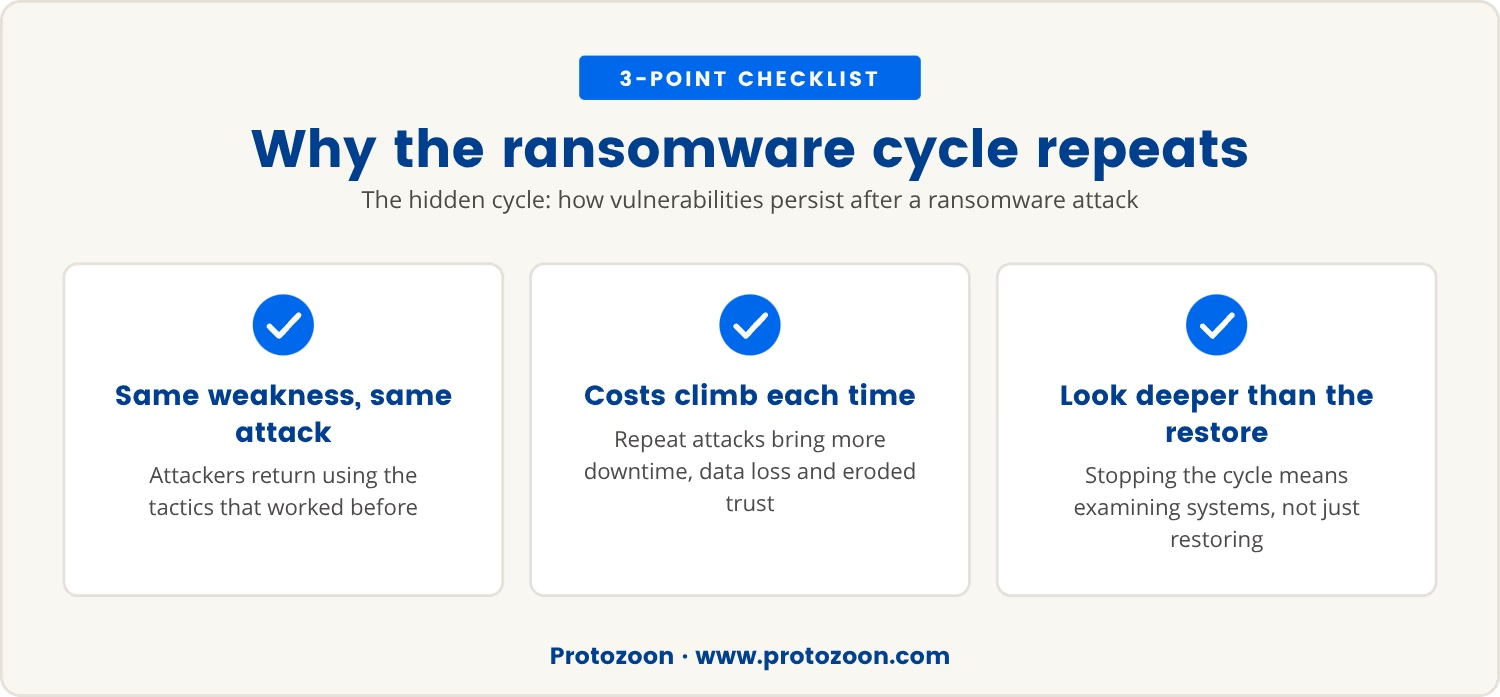
Restoring from backup feels like the finish line for many businesses in London and beyond, but treating it as enough is exactly what lets a dangerous cycle take hold.
Because once the same vulnerability remains in place, attackers simply return using the same tactics that worked the first time. That repetition drives more downtime, more data loss and climbing costs, and each new attack erodes a bit more trust while making the next recovery harder still.
What keeps the cycle going is that the underlying weakness is rarely obvious. It might be a forgotten admin account, a missed software update, or a weak password policy, any of which can survive a basic restore untouched and simply wait to be exploited again.
Stopping that pattern means looking deeper into the systems involved rather than taking the restore at face value. Finding and fixing the actual cause is the only thing that stops future attacks from following the exact same path back in.
Restoring data is only one piece of a genuine ransomware recovery process. A complete version includes several further steps built specifically to stop the same problem returning.
The first priority is halting the spread. Disconnect affected systems from the network straight away and stop any ongoing encryption in its tracks.
With the spread contained, the next step is working out how the attacker got in, checking for phishing, software vulnerabilities or weak credentials.
Only once that vulnerability is identified with confidence should systems be restored from clean backups, since backups that might also be infected should be avoided entirely.
Every relevant security patch and update needs applying at this stage, across operating systems, applications and security tools alike.
User accounts and permissions deserve a close check too: unnecessary accounts should be removed and strong password policies enforced.
Once restoration is complete, close attention to unusual activity matters most, since early detection is what prevents another full-scale incident.
Finally, recording what happened and updating the ransomware response plan accordingly prepares a business for future incidents and strengthens its overall security posture.
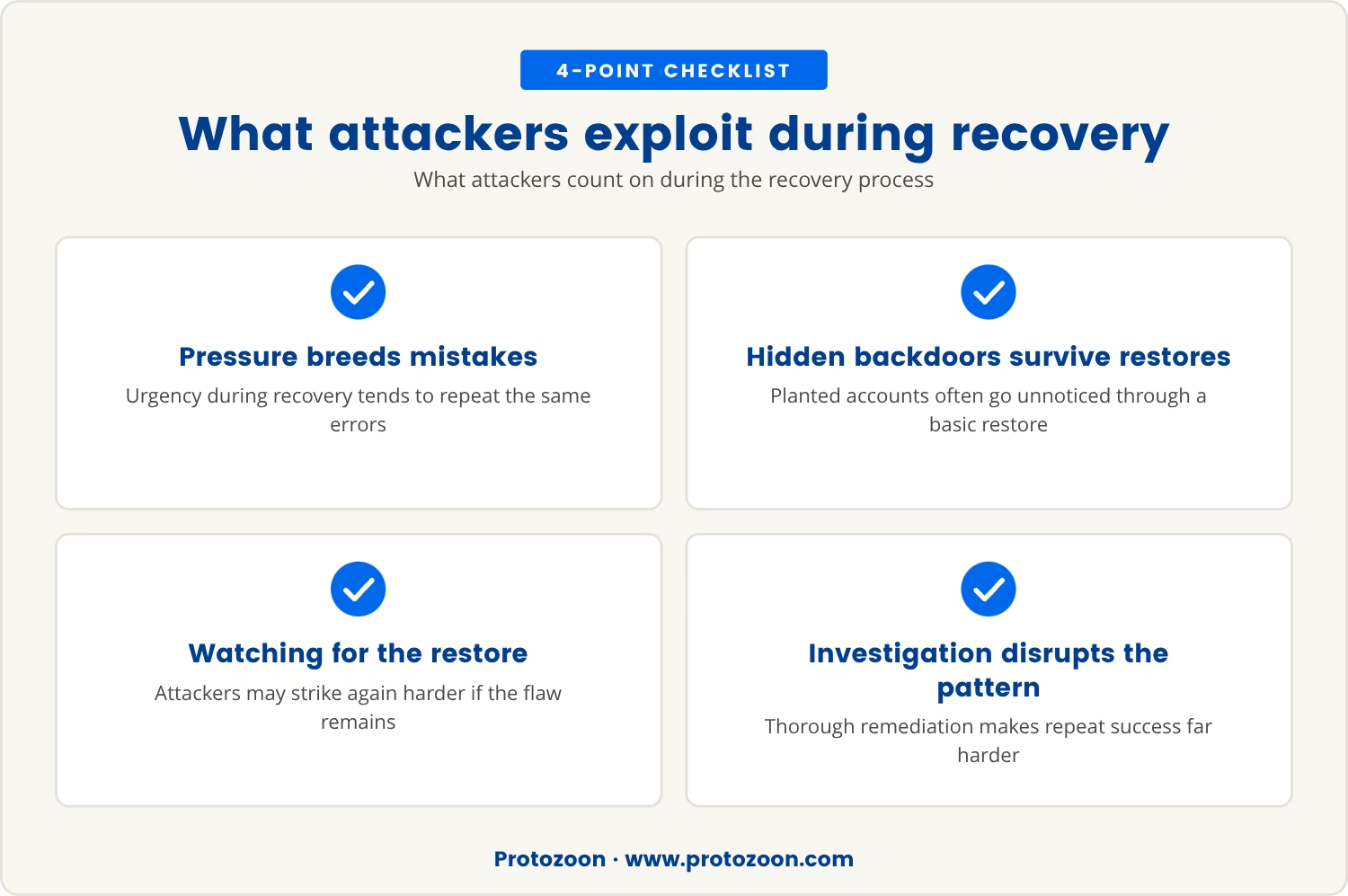
Much of an attacker's advantage comes from predictable behaviour on the business side during recovery, since urgency under pressure tends to produce the same mistakes again and again.
One common tactic is leaving backdoors or hidden accounts designed to survive a basic restore untouched. Left undiscovered, these become a ready-made shortcut for the next attack.
Some attackers go further still, watching for signs that a business is restoring from backup. If the same vulnerability is still sitting there unaddressed, they can strike again, often with greater impact the second time round.
Recognising these tactics is what makes it possible to disrupt them. Careful investigation paired with thorough remediation makes a second success far harder for any attacker to pull off.
A handful of targeted actions can sharply cut the risk of another ransomware attack once recovery is underway:
None of this works as a one-time fix, since lasting protection depends on treating recovery as an ongoing process rather than a single event.
That starts with a ransomware response plan built around regular system reviews and security updates, alongside backups that are both tested and kept isolated from the main network.
Where any step feels uncertain, trusted recovery services are worth bringing in, since outside expertise often catches issues that are easy to miss from the inside.
Beyond that, each incident is worth treating as a lesson in its own right. Every attack exposes something about where the defences held and where they didn't, and that knowledge is what strengthens the systems against repeat incidents.
Skipping the root cause after a ransomware attack often ends up costing more than the first incident did, since each repeat brings fresh downtime, further data loss and renewed damage to reputation.
By contrast, businesses willing to investigate and fix that root cause are far less likely to face the same problem twice, which tends to save both money and stress over the long run.
So if there's any doubt about whether the last recovery closed every gap, that is worth reviewing now rather than later. Has your business ever restored systems without a full investigation?

Many businesses with 1 to 40 users find themselves restoring systems quickly after a ransomware attack, only to face the same risk again. At Protozoon, we understand how frustrating and costly this cycle can be.
If you want to see how we approach root-cause investigation and long-term protection, we invite you to start a conversation about your own setup.
If you’re still paying your old MSP, Protozoon will cover up to 1 month of your remaining charges while you transition to us.
[.mspl-button-text]Start your transition[.mspl-button-text]
Do not restore an infected backup. Look for earlier, clean backups instead, or bring in professional recovery services, and always scan backups for malware before relying on them so the infection cannot simply return.
A strong plan includes regular testing, clearly assigned roles for each team member, and up-to-date contact details for outside experts, reviewed and refreshed after every incident so it stays relevant.
Paying does not guarantee the data comes back or that future attacks stop. Attackers may withhold a working decryption key regardless, and paying can mark a business out as a target for further attacks.
Regular software updates, strong passwords, employee training and secure backups combined make it considerably harder for attackers to succeed.
Recovery time varies with the size of the business, the type of ransomware involved, and the level of prior preparation. Good planning and clean backups speed things up considerably, though thorough investigation is always necessary regardless.

Matt is a technology and cybersecurity expert with extensive experience in networks, compliance, data security, and IT strategy. Known for his practical expertise and personable approach, he helps businesses solve technology challenges, strengthen security, and plan for recovery.
