CTO

A disaster recovery plan only works if it covers five often-overlooked components: roles, recovery time, recovery point, communication, and tested procedures. Missing any one of these creates a hidden weakness that only appears during a real recovery effort.
Most businesses assume that having an IT disaster recovery plan on file means they are covered. In practice, having one proves little; what matters is whether it was built to hold up under real pressure.
That gap between assumption and reality shows up fast once something goes wrong. Systems stall, data disappears, and operations grind to a halt, and even a short spell of downtime can mean lost revenue, missed deadlines, and shaken client trust.
A workable plan is not just about having backups or a checklist, then, but about closing every gap before a crisis exposes it. Left unaddressed, a missing piece stays invisible right up until the moment recovery is meant to work.
At its core, an IT disaster recovery plan is a set of instructions and agreements that help a business get back on track after something goes wrong. Rather than a static document, it is a living process that has to stay clear, practical, and regularly tested — without that, a business is left hoping for the best precisely when it can least afford to.

Many businesses believe they are covered because a disaster recovery plan sits on file somewhere. Yet most checklists only reach the obvious: making backups, naming a contact, listing critical systems. These steps are necessary, but necessary is not the same as sufficient.
A plan that stops at the basics leaves hidden risks untouched. It might say to restore from backup without defining how quickly that must happen or how much data loss is acceptable. It might name a team without clarifying who does what once pressure sets in. None of these gaps show themselves until a real disaster forces action.
So the real test is not whether a plan exists but whether it holds up under stress. Only a plan built around the less obvious pieces — clear roles, recovery time and point targets, communication steps, and a tested recovery procedure — closes the gaps that actually matter.
A reliable disaster recovery plan rests on five components that are often overlooked or never listed together. Each one closes a specific gap, and left open, that gap is exactly what causes recovery to fail when it is needed most.
Everyone involved in recovery needs to know precisely what is expected of them: who leads, who communicates, who restores systems, who checks the results. Without that clarity, confusion slows everything down just when speed matters most.
This is the maximum stretch of time a business can stay offline before the impact turns unacceptable. A clear RTO determines which systems get restored first and how much investment faster recovery deserves.
Where RTO deals with time, RPO defines how much data loss is tolerable — an hour's worth, or only a few minutes. That target then shapes the backup and replication strategy built around it.
A plan also needs to say who is told, when, and how, covering staff, clients, suppliers, and regulators alike. Clear communication is what prevents panic and keeps everyone pulling in the same direction.
A plan never put to the test is really just a theory. Regular, realistic rehearsals reveal what works and what does not, so problems get fixed before a real disaster has the chance to expose them.
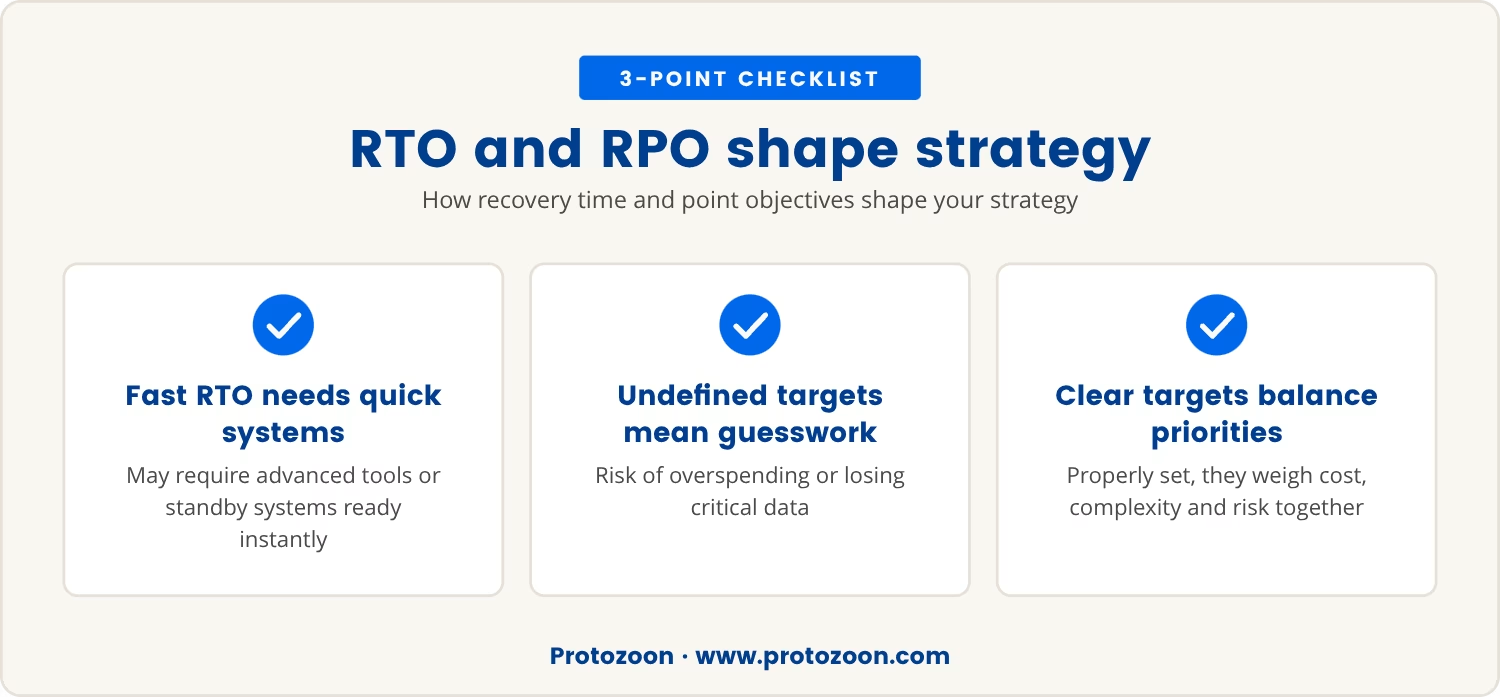
Setting RTO and RPO targets is more than a technical detail tucked into the plan; these two figures decide how the entire recovery strategy gets built.
A short RTO demands systems that can be restored quickly, sometimes within minutes, which might mean leaning on more advanced IT disaster recovery solutions or keeping standby systems ready to go. A strict RPO, in turn, demands backup systems that capture data frequently enough that nothing beyond the acceptable threshold is ever lost.
Leave these targets undefined, though, and a business is left guessing — spending too much on systems it does not need, or too little and risking the loss of critical data. Defined properly, these targets are what balance cost, complexity, and risk against each other.
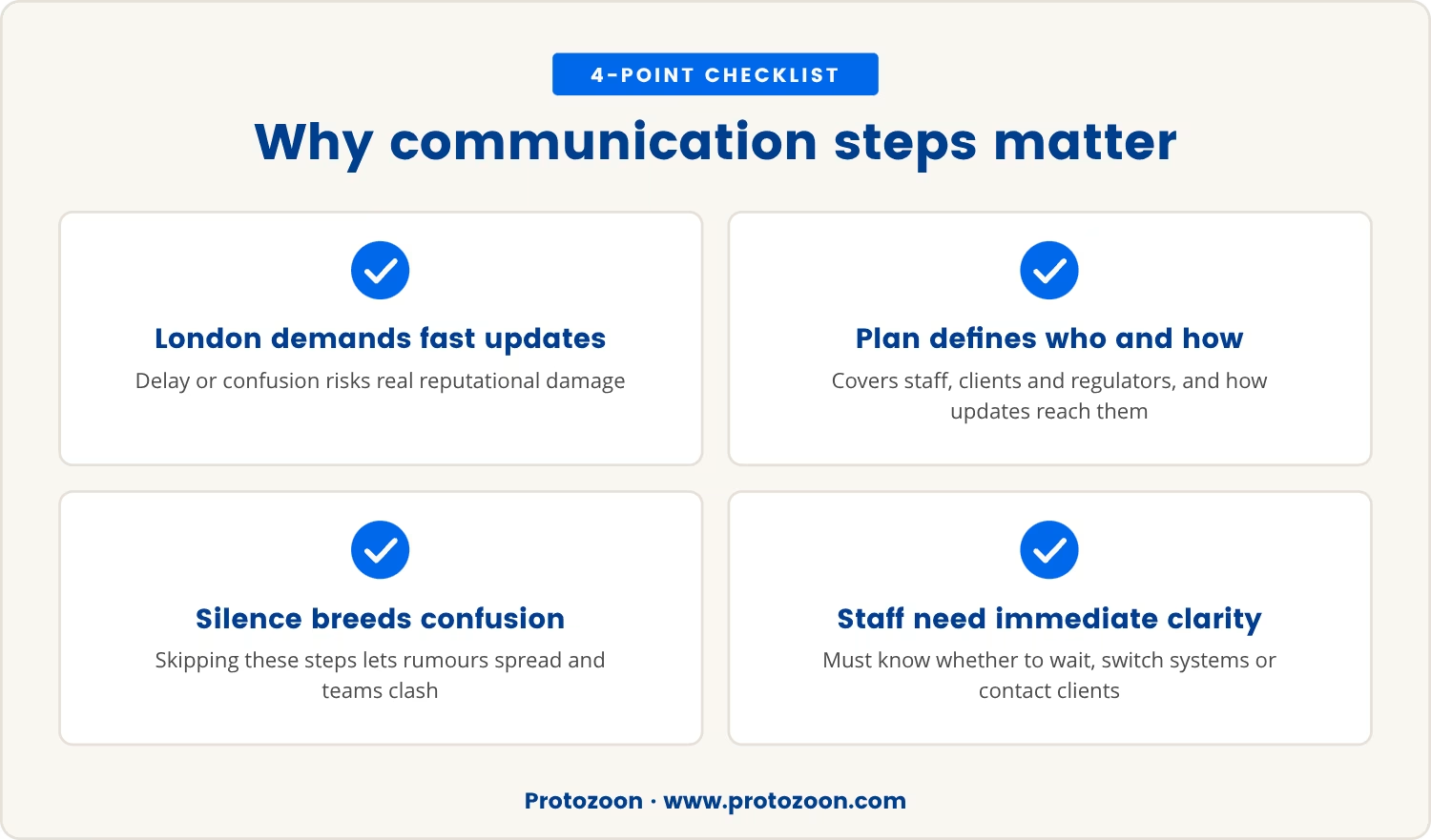
Communication often gets treated as an afterthought in disaster recovery planning, yet it carries just as much weight as the technical steps. In a city like London, where businesses are expected to respond fast and update clearly, any delay or confusion risks real damage to reputation.
A strong plan spells out exactly who needs informing, what they need to know, and how those updates reach them — internal staff, clients, and at times regulators. Skip these steps and rumours spread, clients grow anxious, and teams end up working at cross-purposes.
Picture a main office losing access to key systems: staff need to know immediately whether to wait, switch to backup systems, or contact clients directly, while clients expect honest word about the disruption as it unfolds. A plan that spells out these steps keeps everyone focused and cuts the risk of costly mistakes.
A disaster recovery plan that has never been tested is a risk wearing a disguise. It might look convincing on paper, but real-world conditions have a habit of turning up surprises that no document anticipated.
Testing means running through the steps as though the disaster were actually happening: restoring systems from backup, following the communication steps, checking that everyone understands their role. Each run-through should be as realistic as possible, not a quick glance down a list.
Through that process, gaps surface — instructions that turn out unclear, systems that take longer to restore than expected, staff who hesitate over their role. Fixing these issues before a real disaster strikes is the only way to be confident the plan will actually work.
Even a single missing component can be enough to bring a recovery plan down. Here is what tends to go wrong:
A disaster recovery plan is only as strong as its weakest part, and when one of the five key components goes missing, the gap stays invisible until recovery is already underway. By then, there is no time left to fix it.
The real cost, then, is not only lost data or downtime but the trust and confidence a business has spent years building. Every gap left open is a risk that stays unseen until a crisis exposes it.
So for any business with an IT disaster recovery plan already in place, the question worth asking is simple: does it cover all five components, or is there a gap that only a real disaster would reveal?

If you have 1 to 40 users, you may already have some parts of a disaster recovery plan in place but wonder if it would hold up in a real crisis. At Protozoon, we know that even experienced teams can miss a key step or leave a gap unnoticed until it matters most.
We invite you to see how we approach disaster recovery planning and what a conversation about your current setup could reveal. Let us help you find and close the gaps before they turn into real problems.
We will cover up to one month of your old MSP’s charges while you move to us, so you can transition your disaster recovery support with less financial stress.
[.mspl-button-text]Start your transition[.mspl-button-text]
A disaster recovery plan should be reviewed at least once a year, or whenever there is a major change in IT systems, business operations, or staff roles. Regular reviews keep the plan relevant and effective as the business evolves.
A disaster recovery plan focuses on restoring IT systems and data after a disruption, while a business continuity plan covers how the entire business keeps operating during and after an incident. Both matter, but they address different parts of the recovery process.
Key staff from IT, management, and any department critical to operations should be involved. A range of perspectives helps ensure that every essential system and process is covered and that roles are clearly defined.
Check how often backups are made and compare this against the recovery point objective (RPO): a one-hour RPO needs backups running at least every hour. Testing restores regularly confirms whether the backup process actually meets that target.
The first step is assessing the situation and confirming the type and extent of the disaster. Once that is confirmed, the designated recovery team follows the documented procedures, starting with communication and moving on to system restoration as outlined in the plan.

Matt is a technology and cybersecurity expert with extensive experience in networks, compliance, data security, and IT strategy. Known for his practical expertise and personable approach, he helps businesses solve technology challenges, strengthen security, and plan for recovery.
