CTO
Choosing an IT consultancy based only on price often leads to higher overall technology costs. Short-term savings can result in repeated fixes, increased support expenses, and slower progress on digital transformation.
Picture two quotes landing on your desk for the same IT consulting project: one comes in well under the other, and the temptation to sign with the cheaper firm is immediate, especially when every pound of the budget is already spoken for.
That instinct makes sense on paper, but the invoice total rarely tells the whole story. What you agree to now can set your business up for years of steady growth, or lock you into a cycle of fixes and upgrades that never quite ends.
A single sentence insight: short-term savings on IT consulting often lead to higher expenses down the line, as initial gaps or mistakes need to be corrected later.
That trade-off exists because IT consulting was never just about fixing computers or installing software. It's about helping a business use technology to work better, stay secure, and reach its goals, which is precisely why the right advice heads off problems before they start, while the wrong choice leaves you stuck with systems that never quite fit.

Picking a firm on price alone looks like the sensible, frugal choice at the outset. The catch is that it can introduce costs nobody flagged at the time, and those costs tend to surface later as extra work, unplanned downtime, or a project that has to be redone properly the second time round.
Consider why: a consultant charging less may not spend enough time understanding your business objectives, so the solutions they suggest can miss your workflow or your future plans entirely. That mismatch has a direct consequence - you end up paying for changes or upgrades far sooner than you budgeted for.
A related problem shows up in the paperwork, or the lack of it. Rushed, cut-price projects often leave you with systems only one person truly understands, and if that person moves on, you're left paying just to work out how your own setup functions.
Add it together, and the bargain quietly turns into a drip-feed of small, ongoing expenses that were never listed in the original proposal, yet still land a real blow to the budget over time.
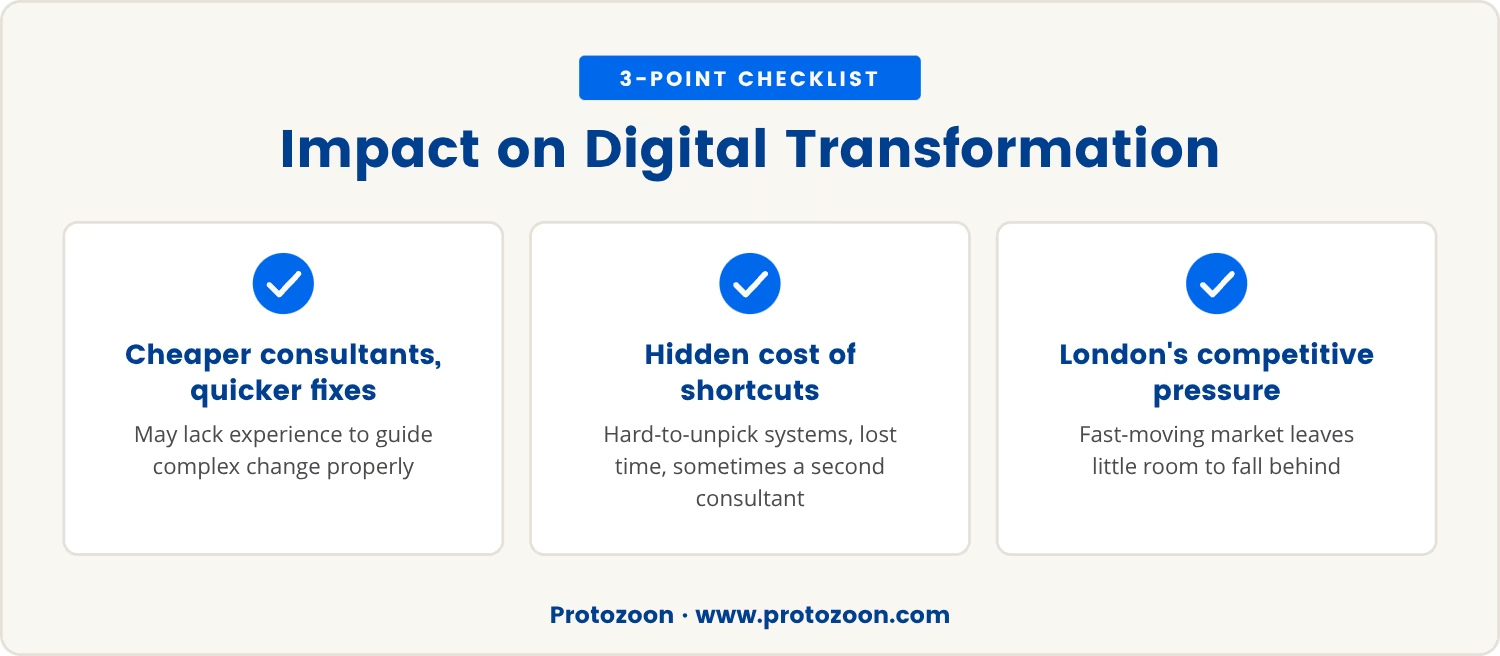
Digital transformation means using technology to change how a business operates, not simply buying new gadgets or software, but reshaping the way work gets done so it's more efficient and competitive. The advice an IT consultant gives shapes how smoothly that shift happens.
Choose on price alone, though, and the whole process can stall. Cheaper consultants may lack the experience or resources to guide a business through complex change, so they default to quick fixes rather than a roadmap built around actual strategy.
That short-term thinking has a cost of its own: systems and processes that are hard to unpick later, time and money spent catching up instead of moving forward, and in some cases a second consultant hired to redo the first one's work - meaning you pay twice for a single outcome.
London businesses feel this pressure especially sharply, given how fast the market moves and how little room there is to fall behind rivals. Lagging on digital transformation can make it noticeably harder to win customers or keep a team productive.
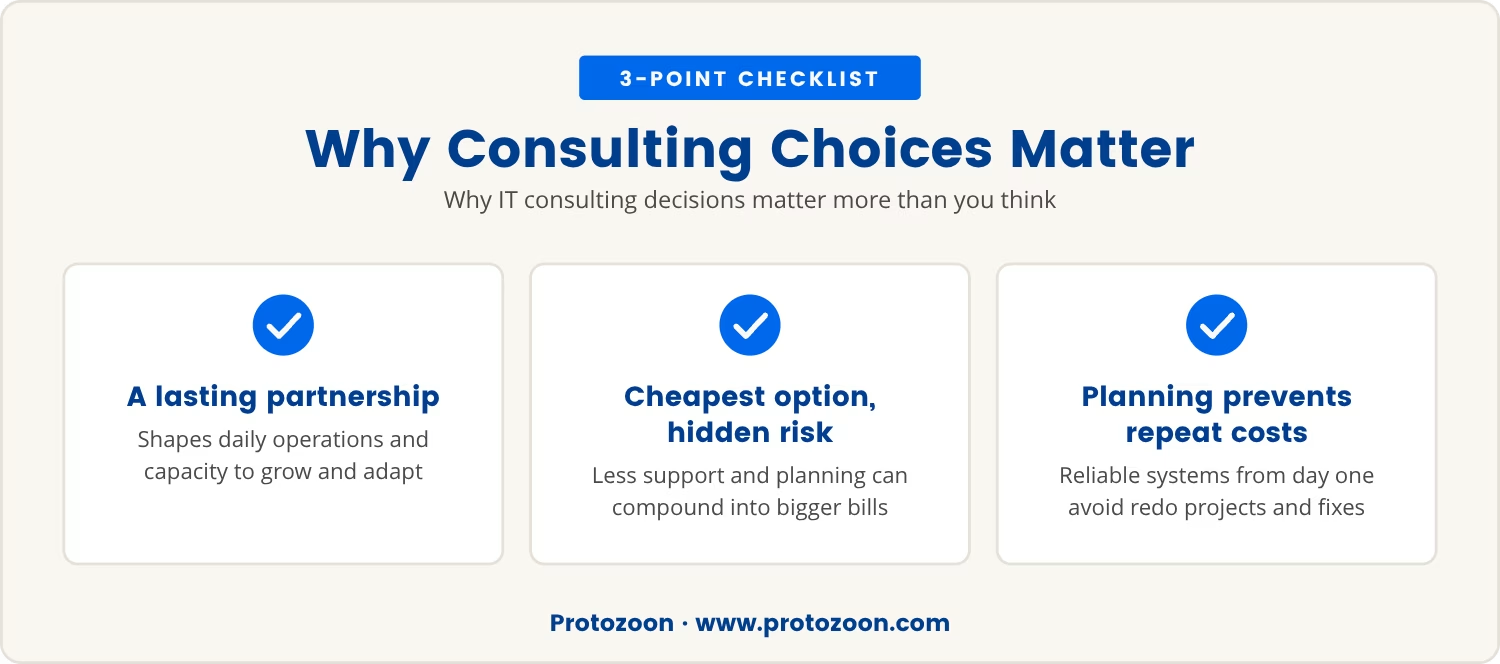
IT consulting works less like a one-off service and more like a partnership that shapes a business's future, touching everything from daily operations to the capacity to grow and adapt. That reach is exactly why the choice of consultant deserves more weight than the quoted price alone.
A good IT consultant takes the time to understand your goals and helps shape a technology strategy around them, looking past the immediate problem to how today's advice plays out months or years from now.
Fixate on price instead, and you risk overlooking the consultants best placed to steer you away from costly mistakes - because the cheapest option usually comes with less support, less planning, and more exposure to risk, and those gaps compound into bigger bills over time.
Anyone who has already paid to redo a project or cover an emergency fix knows how fast those costs stack up. Planning ahead and building reliable systems from day one is how the right consultant keeps you out of that position in the first place.
The savings on a cheap invoice are easy to spot; the costs it stores up for later are not. Here are the most common ways that choosing on price alone ends up raising your technology spend over time:
Work done quickly or cheaply often needs fixing or redoing, which means paying for the same job more than once.
Cheaper consultants may skip ongoing support, leaving you to pay extra whenever something goes wrong.
Without a clear plan, adopting new technology or improving processes becomes a struggle, and growth slows with it.
Low-cost solutions can skip essential cybersecurity steps, leaving a business exposed to threats that are costly to put right.
Incomplete records make systems hard to maintain or upgrade, adding expense every time a change is needed.
Solutions built without future growth in mind force an earlier-than-planned investment in replacement systems.
Given all that, the price tag is the wrong starting point when choosing a consulting firm. A better opening question is how they approach a project and what steps they take to actually understand your business, since a reliable partner focuses on long-term needs rather than just the task in front of them.
From there, check whether they offer clear documentation and ongoing support, ask about their track record with businesses your size, and find out whether they can help you plan for growth. Consultants worth hiring talk about building a technology roadmap, not just firefighting problems as they land.
Their grounding in areas like cybersecurity and cloud computing matters just as much, since these aren't peripheral technical details but the things that keep a business running smoothly and securely day to day.
If you're unsure where to start, think about your own business: have you ever had to pay extra to fix a problem that better planning could have avoided?
IT consultant services go beyond solving technical issues; they align technology with business goals, so every investment actually supports what the business is trying to achieve. That alignment is what turns technology from a cost centre into a competitive edge.
Within that frame, a good consultant helps identify opportunities to improve productivity, streamline processes, and put analytics to work in decision-making, while also flagging emerging technologies likely to matter down the line.
Because the focus stays on long-term success, consultant services built this way help a business sidestep the cycle of rework and extra costs that short-term thinking tends to produce, supporting steadier growth and a stronger competitive position.
For businesses in London, the stakes climb even higher. The city's pace and its expectations mean mistakes are costly and hard to claw back from, so choosing the right IT consultancy London partner can be the difference between steady progress and a string of setbacks.
Local consultants bring something a generic quote can't: familiarity with the area's particular mix of regulation and competition, and the ability to shape a technology strategy around that market specifically. That local knowledge adds value well beyond whatever sits on the initial invoice.
Investing in a consultancy that puts long-term needs first sets a business up for success that extends well past today, carrying forward for years to come.

If you manage a business with 1 to 40 users, you know how easy it is to focus on upfront costs when choosing IT support. At Protozoon, we see how decisions made for short-term savings can lead to bigger expenses later.
We invite you to see how our approach puts long-term value first, whether you want to discuss your current setup or learn how we help businesses avoid repeated rework.
Switching to Protozoon? We’ll cover up to 1 month of your remaining charges with your old MSP while you transition, so you can move forward without double-paying.
[.mspl-button-text]Start your transition[.mspl-button-text]
Look at how they communicate and whether they take time to understand your business objectives, and ask for examples of similar projects they've completed along with details of any ongoing support. A good fit listens, explains clearly, and keeps your long-term needs in focus.
Professional consulting services should go beyond technical fixes to offer clear communication, thorough documentation, and a plan aligned with your business strategy. They should also help prepare your business for future growth and technology change.
Outsourcing saves money when the partner plans for your future and offers reliable support, but choosing on price alone can create hidden costs such as repeated fixes or poor system integration. The best value comes from a partner who understands your needs and helps you sidestep costly mistakes.
An IT consultant plans and manages changes to your technology so each step supports your business goals, guiding the adoption of new systems, the improvement of processes, and ongoing security. Good advice speeds up digital transformation and lowers the risk of expensive setbacks.
Look past the upfront cost to how well your systems run, how often you need support, and whether your technology is actually helping you reach your business objectives. A valuable consultancy reduces long-term costs by preventing problems and supporting steady growth.

Matt is a technology and cybersecurity expert with extensive experience in networks, compliance, data security, and IT strategy. Known for his practical expertise and personable approach, he helps businesses solve technology challenges, strengthen security, and plan for recovery.
