CTO

Five factors—beyond a provider’s size or client list—actually determine if an IT consultancy company will suit a business with under forty users. Missing these means risking a contract that won’t adapt as your business changes.
When IT support can't flex with a growing team, the costs show up fast: you pay for seats nobody uses, or you scramble for extra capacity you should already have. A contract that can't bend is the real expense, long before any invoice arrives.
If you're searching for an IT company London businesses trust, the question isn't which provider looks biggest but which one won't leave you boxed in as headcount shifts. The usual advice — pick the largest name, pick the one with the flashiest client list — rarely addresses that question at all.
That's because the real risk sits elsewhere: getting locked into a contract that can't adapt as the business changes shape. Which points to a sharper insight: the best IT consultancy company for a small team is rarely the one that simply looks impressive on paper.
Given that, the right fit comes down to a handful of less obvious factors — the details that decide how well IT support actually holds up day in and day out, and that can spare a growing team real headaches later.

Many businesses assume a large IT solutions company, or one boasting a big-name client list, is automatically the safest bet. That assumption overlooks what actually matters for teams with under forty users.
A large provider may command more resources, yet resources alone don't guarantee services flexible enough for a smaller operation. Some of the biggest companies run on rigid processes built for much larger organisations, which can leave smaller teams overlooked or squeezed into packages that were never designed for them.
A long client list carries a similar problem: it looks impressive, but length alone doesn't prove the provider understands what smaller businesses actually face. What works smoothly for a company with hundreds of employees rarely translates to a team of twenty or thirty without friction.
The better approach, then, is to judge a provider by how well it works alongside a business as that business grows or changes shape. These are the details separating a service that genuinely supports a team from one that quietly holds it back.
Surface details are easy to get distracted by, but five separate factors actually determine whether an IT consultancy company will suit a given business. Each one shapes the daily experience of working with a provider, and each one affects how well that provider keeps pace as needs shift.
How an IT company communicates sets the tone for the entire relationship. Technical jargon and slow replies leave a team guessing, so the better signal is a provider that explains things plainly and responds fast enough that nobody is ever left in the dark.
Just as communication sets the tone, a provider's willingness to adapt its support shapes what the relationship costs. Some companies offer only fixed packages, while others tailor support to actual need — and for a team under forty, that flexibility is the difference between paying for unused extras and missing help that's genuinely required.
Beyond flexibility in service sits flexibility on paper: the contract itself. Notice periods, terms for scaling up or down, and exactly what the monthly fee covers all deserve scrutiny, because a good IT consultancy company stays transparent on these points and makes the agreement easy to adjust as the business changes.
Clarity on paper matters less, though, if the provider has never worked with a business like this one. What counts isn't the number of clients but whether there's relevant experience behind them, so it's worth asking for examples of support in London for teams of a similar size or industry — proof the provider understands the challenges at hand and can offer advice that actually applies.
Relevant experience still falls short if the provider only reacts once something has already broken, costing time and money in the process. The stronger alternative is a company that specialises in proactive monitoring and maintenance, catching problems before they disrupt the business at all.
Having set out the five factors, flexibility deserves a closer look, since for a small business in London it isn't a nice-to-have but a precondition for smooth operation. Whatever changes — team size, budget, technology needs — the way an IT company London provider absorbs that change shapes how steadily the business runs.
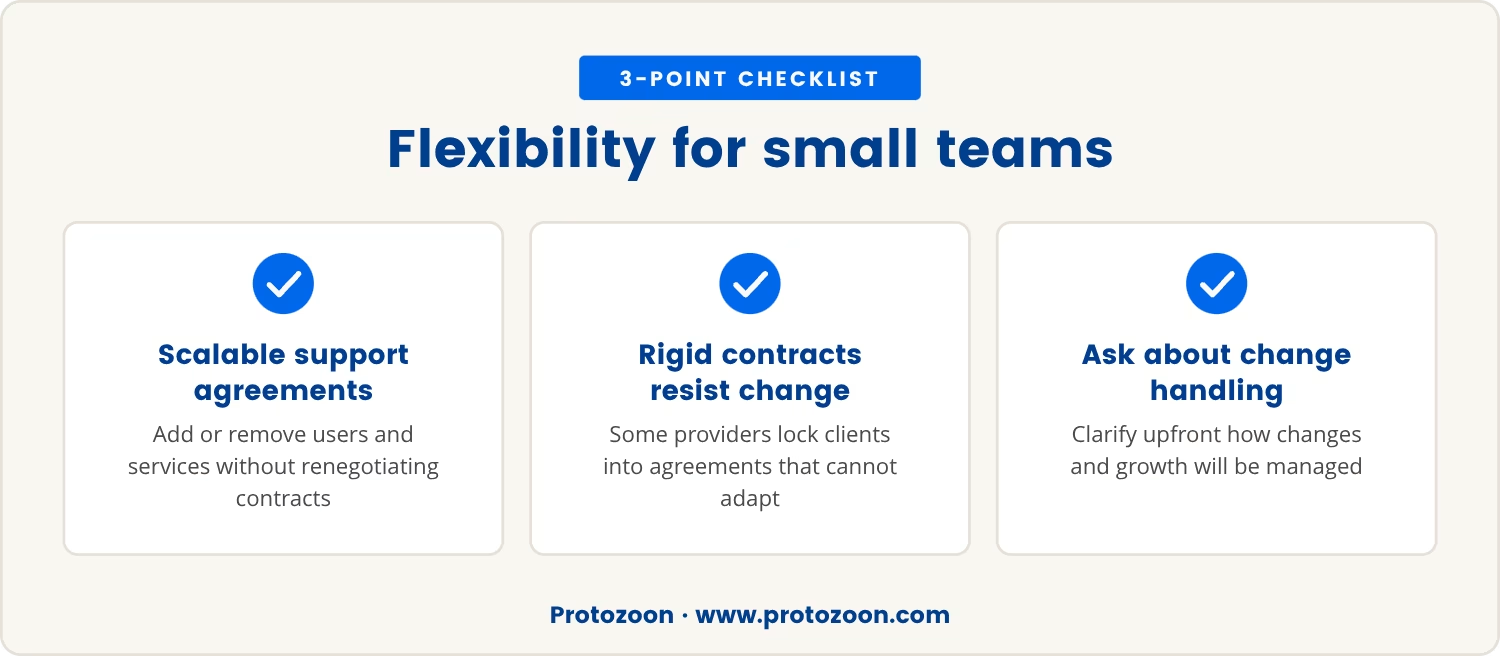
Some providers offer managed IT services that scale up or down in step with the business, letting a team add or remove users, adjust service levels, or switch technologies without renegotiating the whole contract. A team growing from 15 to 30, for instance, should see its support grow alongside it, without hidden fees or delays creeping in.
Others lock clients into rigid agreements that resist adaptation, leaving a business paying for services it no longer needs or scrambling for support when circumstances shift. The better providers make adjustment simple, so a setup never outlives its usefulness.
Anyone who has had to change an IT setup in a hurry already knows how disruptive an inflexible provider can be. That disruption is exactly why it's worth asking upfront how changes get handled and what options exist as the business evolves.
Given how much flexibility matters in practice, the questions asked before signing are what actually reveal it. Choosing an IT consultancy company is a significant decision, and the right questions expose whether a provider truly fits:
Asking these questions helps cut through the sales pitch and shows how a provider will actually work day-to-day.
Those same questions matter because the wrong answer carries a cost that isn't obvious at the point of signing. It's tempting to choose on price or reputation alone, but the real expense of a poor fit tends to surface only once the contract is already running, and it accumulates quietly from there.
When IT support can't adapt as the business changes, unused services pile up on the invoice, or new ones get added in a rush — either way, operations slow and the team grows frustrated.
Locked-in contracts compound the problem: switching providers becomes expensive when things aren't working, since some companies charge steep exit fees or demand long notice periods that make leaving difficult even for an unhappy client.
On top of that sits the risk of downtime or security trouble when a provider isn't proactive, since small problems left uncaught quickly turn into large ones. All of which is why it pays to look past the surface and weigh the factors that genuinely matter.
Having seen what the wrong choice costs, it's worth setting out what the right one looks like. A good IT solutions company doesn't just meet today's needs — it's built to grow alongside the business, and a few signs make that clear:
A provider ticking these boxes is far more likely to become a long-term partner rather than a short-term fix.
Taken together, these signs point to one conclusion: the right IT consultancy company for a small team is decided by neither size nor reputation alone. It comes down instead to the combination of communication, flexibility, contract clarity, relevant experience, and a proactive approach — the mix that sets the strongest providers apart from the rest.
Weighing these factors is what helps a business avoid contracts that can't adapt and support that can't keep pace. What results is an IT partnership that grows alongside the business rather than holding it back.

If you’re running a business with 1 to 40 users, it’s easy to feel overlooked by IT providers who focus on bigger clients. At Protozoon, we understand how important it is for your support to adapt as your business grows and changes.
We invite you to see how our approach puts your needs first—whether you want to discuss your current setup or explore how managed IT services can scale with you.
If you’re still paying your old MSP, we’ll cover up to 1 month of your remaining charges while you transition to us.
[.mspl-button-text]Start your transition[.mspl-button-text]
Look for a provider offering flexible support, quick response times, and clear contract terms, one willing to tailor its services to a team's actual size and needs rather than forcing a standard package onto it.
Expect personal attention, solutions built around the business rather than generic ones, and an ability to adapt as needs change. A good provider avoids overcomplicating things and focuses on practical, reliable systems that keep work efficient.
Yes — many providers combine immediate support for daily problems with advice on long-term IT strategy, a pairing that keeps a business productive now while preparing it for future growth.
Managed IT services typically include ongoing monitoring, maintenance, and proactive problem-solving, whereas traditional support tends to react only once something breaks. The managed model is built to prevent issues before they disrupt the business at all.
Ask for examples of other businesses supported in the same sector or of a similar size. Providers with that kind of relevant experience are far more likely to understand the challenges at hand and offer solutions that actually fit.

Matt is a technology and cybersecurity expert with extensive experience in networks, compliance, data security, and IT strategy. Known for his practical expertise and personable approach, he helps businesses solve technology challenges, strengthen security, and plan for recovery.
