CTO

Most insider threat incidents are caused by careless mistakes, not deliberate sabotage. Defences that only look for malicious intent miss the majority of real risks inside a business.
Picture how an insider threat usually unfolds inside a business: not a deliberate scheme, but a chain of ordinary actions that quietly goes wrong. Someone clicks a suspicious link, or sends sensitive data to the wrong recipient, and a system built to catch deliberate harm never registers the moment as a threat at all.
That mismatch matters because most incidents are never planned. They are accidents that slip past defences designed with a different kind of actor in mind. More than half of all insider incidents are caused by negligence, not malice, which means most businesses are exposed in ways they would not think to guard against.
Focus only on catching those who mean harm, then, and the most common risk is the one left unguarded. Seeing how these mistakes actually happen is the first step towards closing that gap.

Many businesses invest in cybersecurity tools built to flag someone trying to steal, damage or misuse data on purpose. Yet the real cost often comes from errors nobody meant to make: a forgotten laptop left on a train, an email sent to the wrong address, a weak password reused across accounts.
The outcome does not care about intent. When a staff member slips up, the damage can be just as severe as a planned attack, with sensitive data exposed or systems left open to outsiders. What sets these incidents apart is how hard they are to predict, since they never follow the pattern a typical insider attack would leave behind.
Businesses in London face the same difficulty as those anywhere else: spotting a risk that looks exactly like normal work until the moment it is not. Closing that gap takes more than extra technology - it takes a shift in how risk itself is understood.
Security systems are usually built to catch the obvious signs of a malicious insider - someone reaching for files they should not touch, or moving large volumes of data out of the network. That design relies on spotting behaviour that signals intent to harm.
A careless mistake, though, rarely looks like that. The employee is simply doing their job, with one slip embedded in otherwise ordinary activity, which is exactly why traditional threat detection tools are not tuned to notice it.
That gap means even strong technical controls can miss the majority of real incidents. Watch only for clear signs of malice, and the everyday errors causing most of the damage pass straight through unnoticed.
Spotting insider threat is not only about catching bad actors; it is about recognising the patterns that lead to mistakes before those mistakes turn costly. The strongest detection strategies pair technology with practical steps aimed squarely at human error.
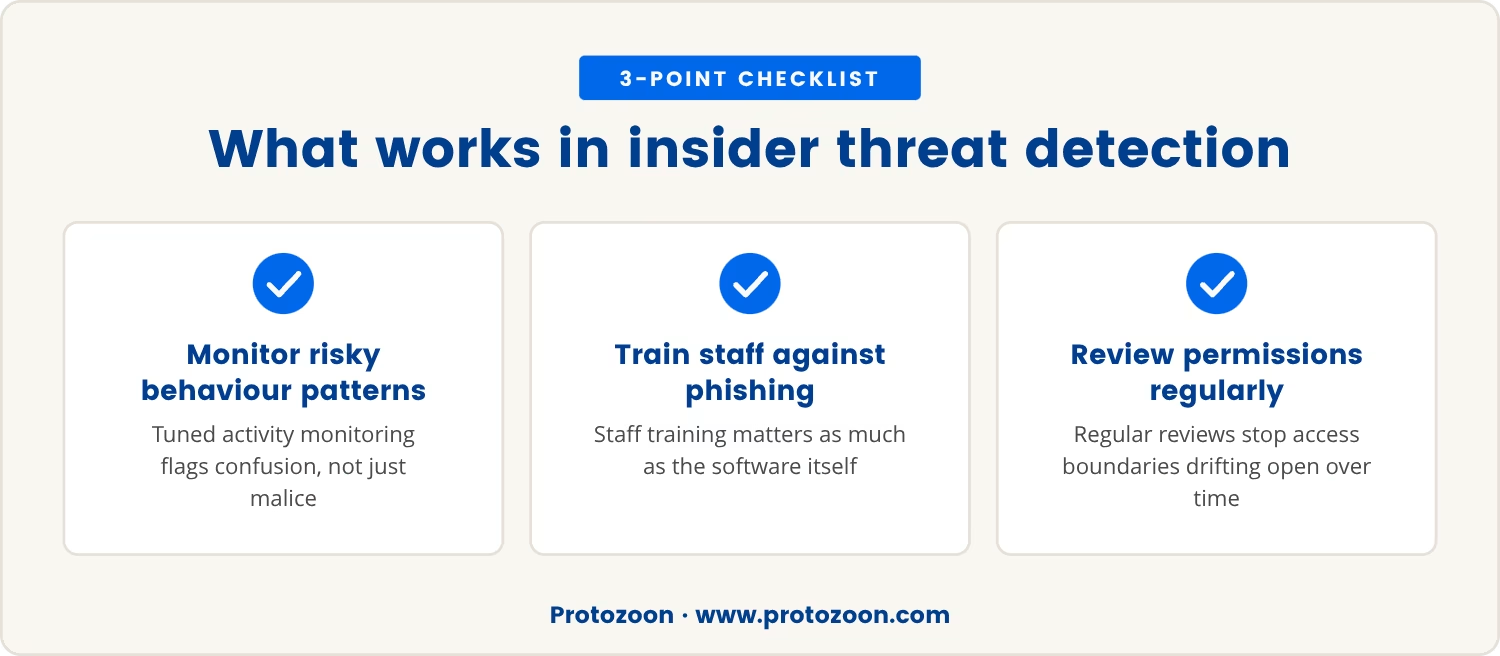
User activity monitoring plays a part, but only when it is tuned to notice risky behaviour that is not always intentional - repeated failed logins or attempts to reach restricted files, for instance, often signal confusion rather than malice. Alongside that, training staff to recognise phishing attempts and sidestep common traps matters just as much as the software itself.
Access control rounds out the picture. Limiting who can see or change sensitive data shrinks the reach of any single mistake, and regular reviews of permissions keep that boundary from drifting open over time.
Accidents are hard to predict outright, but certain warning signs tend to appear before trouble does. Watch for these indicators in particular:
Cutting the risk of unintentional mistakes starts with folding security into everyday work rather than treating it as a separate task. Clear policies, regular training and simple processes give staff a plain sense of what is expected and why.
Running phishing simulations regularly is one practical step, helping staff recognise suspicious emails and know what to do when something looks wrong. Pairing that with tighter access - sensitive data reaching only those who genuinely need it - closes much of the remaining gap.
Beyond process, culture carries real weight: when people feel safe reporting mistakes without fear of punishment, problems surface early enough to fix before they spread.
Leaders set the tone for how seriously security gets taken across a business. When managers speak openly about mistakes and how to avoid them, staff tend to pay closer attention, and clear expectations paired with regular reminders keep security from fading into the background.
Equally, leaders do well to invest in tools that support staff rather than simply watch them. Easy-to-use systems, clear instructions and quick support all reduce the chance that an honest error turns into a breach.
Defences built mainly to catch deliberate attacks miss the bigger picture, because most incidents trace back to simple mistakes rather than planned sabotage. Widening that focus to include unintentional risk protects a business against the threats that actually matter most.
Ask yourself: are the security measures in place designed to help staff avoid mistakes, or only to catch them afterwards? The answer could decide how well an organisation stands up to the risks already inside its walls.

If you have 1 to 40 users, you might be relying on systems that only catch obvious attacks, while accidental mistakes go unnoticed. At Protozoon, we understand how easily these risks can slip through.
We invite you to see how our approach helps businesses like yours address the real causes of insider incidents. Let’s talk about what would make your setup safer and easier for your team.
We will cover up to 1 month of your remaining charges with your old MSP when you move to us, making your transition smoother and less costly.
[.mspl-button-text]Start your transition today[.mspl-button-text]
An insider is anyone within an organisation who holds access to systems or data, including employees, contractors or partners. A malicious insider is someone who uses that access deliberately to cause harm, steal information, or disrupt operations, though most insider incidents trace back to mistakes rather than intent.
Watch for patterns such as repeated password resets, unusual file sharing, or data being accessed at odd times. These signs do not always point to bad intent, but they can reveal confusion or risky habits capable of leading to real problems.
Begin with clear security policies and regular training across the whole team. Limit access to sensitive data, run phishing simulations, and encourage staff to report mistakes without fear of blame - simple, practical steps that tend to suit smaller teams best.
Threat detection tools are generally built to catch deliberate attacks, which leaves everyday mistakes slipping past unnoticed. Pairing that technology with training and clear processes catches both the intentional and unintentional risks before they escalate.
Access control restricts who can view or change sensitive data, so a simple error is far less likely to cascade into a major breach. Reviewing permissions regularly keeps that boundary strong rather than letting it quietly loosen over time.

Matt is a technology and cybersecurity expert with extensive experience in networks, compliance, data security, and IT strategy. Known for his practical expertise and personable approach, he helps businesses solve technology challenges, strengthen security, and plan for recovery.
